
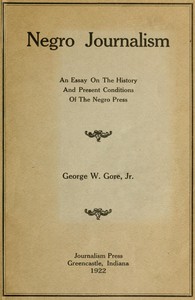
Negro Journalism: An Essay on the History and Present Conditions of the Negro…
George William Gore's Negro Journalism is a foundational look at a world many of us never learned about in school: the vibrant, essential, and defiant universe of Black newspapers in America.
The Story
The book isn't a novel with a single plot, but it tells a powerful story. Gore starts at the very beginning, with papers like Freedom's Journal in 1827, founded with the clear mission to champion abolition and counter racist propaganda. He then guides us through the pivotal role of the Black press during Reconstruction, documenting the hope and the harsh backlash. We see how these papers reported on the Great Migration, World War I, and the rise of the Harlem Renaissance. The 'characters' are the pioneering editors and reporters themselves—people who risked everything to publish, facing economic pressure, violence, and sheer indifference. The narrative arc is their relentless push to create a platform for debate, celebrate Black achievement, and fight for civil rights, long before those struggles were headline news in white-owned papers.
Why You Should Read It
Reading this feels like uncovering a secret history. It makes you realize how much of our understanding of the past comes from who was holding the pen. Gore shows that for Black communities, their newspaper was often the most trusted institution—more than the government or the mainstream press. It was where you found job listings, learned about social events, read poetry, and saw your leaders debated. The themes are immediate: the power of community information, the battle against misinformation, and the sheer courage it takes to speak truth to power. It reframes the entire idea of 'the media' and makes you think critically about whose stories get told today.
Final Verdict
This book is perfect for anyone interested in the real history of American media, social justice movements, or Black history beyond the usual names and dates. It's especially valuable for journalists, bloggers, and communicators of any kind, as a reminder of the profound responsibility that comes with a platform. While it's an academic essay at its core, Gore's passion for his subject makes it accessible. Be ready for a read that will fill in huge gaps in your knowledge and likely make you look up some of the incredible newspapers he mentions. A vital piece of the puzzle for understanding America.
This work has been identified as being free of known copyright restrictions. Enjoy reading and sharing without restrictions.
Charles Thompson
2 years agoLooking at the bibliography alone, the bibliography and references suggest a high level of research and authority. I'm genuinely impressed by the quality of this digital edition.
Kimberly White
9 months agoIf you're tired of surface-level information, the author manages to bridge the gap between theory and practice effectively. This has become my go-to guide for this specific topic.
Kimberly Martin
2 months agoI started reading this with a critical mind, the inclusion of diverse viewpoints strengthens the overall narrative. Well worth the time invested in reading it.
Charles Davis
9 months agoAs a long-time follower of this subject matter, it manages to maintain a consistent flow even when discussing difficult topics. It’s hard to find this much value in a single source these days.









Joseph Anderson
1 year agoIf you're tired of surface-level information, the data points used to support the main thesis are quite robust. I'm glad I chose this over the other alternatives.