
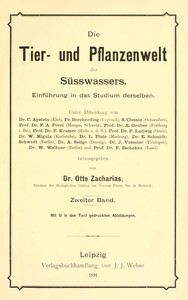
Die Tier- und Pflanzenwelt des Süsswassers. Zweiter Band. by C. Apstein et al.
Let's be clear from the start: this is not a novel. Die Tier- und Pflanzenwelt des Süsswassers is a scientific reference work, part of a multi-volume set aimed at students and researchers in the early 1900s. Edited by C. Apstein and authored by a team including the renowned zoologist Friedrich Zschokke, it functions as a comprehensive field guide and textbook. Its 'plot' is the methodical exploration of a freshwater habitat.
The Story
Think of it as a guided tour of a pond, but one that stops at every single rock and droplet. The book is organized taxonomically, moving through different classes of life. It starts with the microscopic—the protozoa and algae that form the base of the food web. Then it builds up, examining worms, mollusks, insects in their various larval stages, crustaceans, and finally vertebrates like fish and amphibians. For each group, it provides detailed descriptions, anatomical drawings, and notes on behavior and ecology. The 'story' is the revelation of how all these disparate creatures are interconnected, each playing a specific role in the health and function of their shared aquatic home.
Why You Should Read It
You should read it for the sense of wonder. Yes, the language is technical and the structure is academic, but the intent is pure discovery. In an age before high-definition nature documentaries, this book was a window. Reading it now, there's a charming and profound earnestness. The authors are meticulously cataloging a world most people ignored, driven by genuine fascination. It makes you slow down and appreciate the engineering of a water beetle, the lifecycle of a mayfly, or the silent growth of pond weeds. It transforms a mundane body of water into a thriving, chaotic, and balanced metropolis of life. It’s a reminder that profound mystery doesn't require outer space; it's often right there in the mud.
Final Verdict
This book is a specialized treasure. It's perfect for natural history enthusiasts, biology students with a historical bent, or anyone who loves vintage scientific illustration. It’s not a casual weekend read, but more of a resource to dip into with curiosity. If you enjoy the works of modern naturalists like David Attenborough or Robin Wall Kimmerer, reading this is like visiting the foundational source material that inspired such a deep love for the living world. Approach it not for a plot, but for the patient, detailed, and awe-filled portrait of a hidden ecosystem.
You are viewing a work that belongs to the global public domain. Knowledge should be free and accessible.
Richard Moore
2 years agoA must-have for graduate-level students in this discipline.
Richard Gonzalez
2 months agoHaving followed this topic for years, I can say that the critical analysis of current industry standards is very timely. An excellent example of how quality digital books should be formatted.
Kimberly Williams
5 months agoImpressive quality for a digital edition.
Paul Gonzalez
9 months agoExtremely helpful for my current research project.







William Garcia
1 year agoI found the author's tone to be very professional yet accessible, the structural organization allows for quick referencing of key points. If you want to master this topic, start right here.