
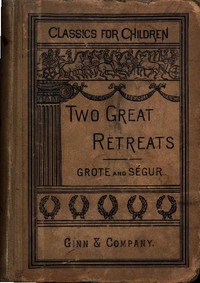
The Two Great Retreats of History by George Grote and comte de Philippe-Paul Ségur
This book is actually a two-for-one historical package. The first part, by George Grote, covers the ancient 'Retreat of the Ten Thousand' Greeks from Persia in 401 BC, a story of disciplined soldiers fighting their way home against all odds. It's a classic tale of endurance. But the heart and soul of this volume—the part that truly haunts you—is the second account by Count Philippe-Paul de Ségur.
The Story
De Ségur was a French nobleman who served on Napoleon's personal staff. His section focuses entirely on the 1812 invasion of Russia and the horrific retreat that followed. We see the Grand Army, confident and massive, march into Moscow, only to find a deserted, burning city. Then, the decision to turn back as winter closes in. What follows is not a military analysis, but a visceral, eyewitness chronicle of collapse. De Ségur describes the relentless cold that killed men mid-step, the scramble for scraps of food, the abandonment of the wounded, and the constant attacks by Cossack cavalry. He watches the breakdown of order and the transformation of a proud army into a desperate, shattered horde. It's the story of a retreat where nature itself was the greatest enemy.
Why You Should Read It
You should read this because it removes the myth and shows the raw human cost. History often remembers Napoleon as a genius and his campaigns as grand chess games. De Ségur pulls you into the mud and snow beside him. You feel the absurdity of officers in fine uniforms dying of hunger, and the tragedy of thousands vanishing in a Russian blizzard. His perspective is fascinating—he's loyal to Napoleon, yet he cannot hide the scale of the disaster. The book's power comes from its terrifying intimacy. It’s a masterclass in how a single, well-placed observer can capture the emotional truth of a historical event better than any textbook summary ever could.
Final Verdict
This is perfect for anyone who loves immersive history or classic war memoirs. If you enjoyed the personal feel of 'With the Old Breed' or the tragic scale of 'The Worst Journey in the World,' you'll appreciate de Ségur's account. It's also a great pick for Napoleon buffs who want to see the legend stripped bare by one of his own men. A word of caution: it’s not a light read. The suffering is relentless. But for a breathtaking, first-person journey into one of history's most famous military catastrophes, you can't get much closer than this.
This digital edition is based on a public domain text. Distribute this work to help spread literacy.
Matthew Harris
2 months agoI've been looking for a reliable source on this topic, and the author’s unique perspective adds a fresh layer to the discussion. A mandatory read for anyone in this industry.










Patricia Thomas
1 year agoThis digital copy caught my eye due to its reputation, the concise summaries at the end of each section are a lifesaver. A rare gem in a sea of mediocre content.