
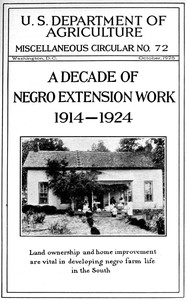
A decade of negro extension work, 1914-1924 by O. B. Martin
Let's be clear from the start: this isn't a beach read. 'A Decade of Negro Extension Work' is an official report, written in 1924 by O. B. Martin, a white administrator who oversaw the program. It chronicles the first ten years of a groundbreaking effort: sending Black agricultural agents into Southern Black communities to teach modern farming and home economics.
The Story
The 'story' is one of building from nothing. In 1914, with funding from the Smith-Lever Act, the USDA created a separate extension service for Black farmers, who were ignored by the main (white) agents. The book follows the work of the first agents—people like Thomas M. Campbell and John B. Pierce—as they travel county by county. They faced deep distrust. Why should farmers, often sharecroppers with no land of their own, listen to a government man? The agents had to prove their worth. They did it through pure, practical action: showing how a new corn variety could yield more, teaching women to sew and preserve food to save money, helping families build sanitary privies to fight disease. The book is a ledger of this work, filled with tables listing the number of 'demonstration farms' and 'canning clubs.' The narrative is the data itself, telling a story of incremental, hard-won change.
Why You Should Read It
You should read it to witness a form of genius that gets overlooked. In an era of blatant oppression, these agents practiced what we might now call 'under-the-radar' community development. They couldn't challenge segregation head-on, so they worked within its cruel confines to make life materially better. Their tool was knowledge, and their goal was self-sufficiency. Reading their dry reports on pig breeding or tomato contests, you start to see it as a radical act. They were building economic resilience and pride in a population that was being systematically stripped of both. It reframes the early 20th-century South not just as a place of tragedy, but also of determined, pragmatic nation-building within the Black community.
Final Verdict
This book is a specialist's treasure but also has something for any curious reader. It's perfect for history buffs who want to go beyond politics and wars to see how change actually happened on the ground. It's great for anyone interested in agriculture, community organizing, or Black history. The writing is straightforward and factual, so don't expect dramatic prose. But if you're willing to read between the lines of crop reports and meeting summaries, you'll find a profoundly moving account of dignity and diligence. It's not an easy read, but it is an important and surprisingly inspiring one.
This title is part of the public domain archive. Knowledge should be free and accessible.
Paul Miller
9 months agoIt took me a while to process the complex ideas here, but the argument presented in the middle section is particularly compelling. It’s a comprehensive resource that doesn't feel bloated.
John Miller
7 months agoMy first impression was quite positive because the author doesn't just scratch the surface but goes into meaningful detail. I appreciate the effort that went into this curation.
Emily Martinez
1 year agoThe index links actually work, which is rare!
Mason Miller
2 years agoAfter hearing about this author multiple times, the atmosphere created is totally immersive. Truly inspiring.






Ashley Williams
2 years agoAs someone working in this industry, I found the insights very accurate.