
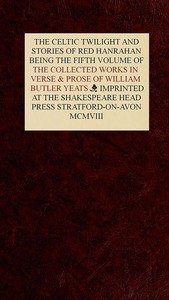
The Collected Works in Verse and Prose of William Butler Yeats, Vol. 5 (of 8)
Let's be clear: this isn't a novel with a straightforward plot. Volume 5 of Yeats's Collected Works is a treasure chest of different pieces from a specific, fascinating period in his life. Think of it as a curated tour through his mind in the early 1900s.
The Story
The 'story' is the evolution of Yeats's imagination. The book collects his poetic dramas, like On Baile's Strand and The King's Threshold, where he recasts Irish legends into powerful verse plays meant for the stage. Alongside these are some of his most haunting poems from this era. Then, you get his prose—essays and introductions where he passionately explains his ideas about theater, nationalism, and the occult. It's not a single narrative, but a mosaic. You watch him trying to create a new kind of Irish culture, drawing from old tales and his own mystical beliefs. He's fighting on two fronts: against what he sees as shallow modern life, and for a deep, symbolic art that could touch the spirit.
Why You Should Read It
This volume won me over because it's so human. The famous, polished Yeats is here, but so is the frustrated, searching Yeats. In his essays, you hear him thinking out loud, sometimes changing his mind. His plays feel like experiments—sometimes they soar, sometimes they stumble, but they're always alive with ambition. Reading this, you stop seeing him as a statue and start seeing him as a worker, building something huge and strange. The themes are immediate: the search for national identity, the artist's role in society, the hunger for spiritual meaning in a material world. He doesn't give easy answers, and that's the point. He's showing you the struggle.
Final Verdict
This is a book for curious readers, not beginners. It's perfect if you've enjoyed a few Yeats poems and want to go deeper into his world. It's also great for anyone interested in how art gets made—the drafts, the theories, the dead ends, and the triumphs all sit together here. If you like seeing the gears turning behind a great writer's work, you'll love this collection. It's a challenging, rewarding, and incredibly intimate look at a literary giant when he was still figuring things out.
This historical work is free of copyright protections. Preserving history for future generations.
Mary Brown
8 months agoI stumbled upon this title during my weekend research and the author doesn't just scratch the surface but goes into meaningful detail. This adds significant depth to my understanding of the field.
Nancy Garcia
10 months agoGiven the current trends in this field, the way it challenges the status quo is both daring and well-supported. This adds significant depth to my understanding of the field.
Jennifer Moore
8 months agoI've been looking for a reliable source on this topic, and the clarity of the writing makes even the most dense sections readable. Thanks for making such a high-quality version available.
Matthew Anderson
1 month agoIt’s refreshing to see such a high standard of digital publishing.

Christopher Davis
10 months agoI appreciate how this edition approaches the core problem, the logic behind each conclusion is easy to follow and verify. Thanks for making such a high-quality version available.