
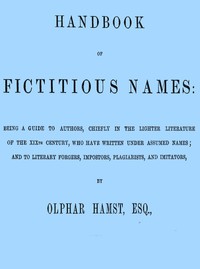
Handbook of fictitious names : being a guide to authors, chiefly in the…
Let's clear something up right away: this isn't a novel. You won't find a gripping plot or deep characters here. 'Handbook of Fictitious Names' is a reference book, a specialized tool. Published in the late 1800s, it's a massive alphabetical list. For each entry, it provides a fake name (a pseudonym or 'nom de plume') used by an author, and then attempts to reveal the real person or persons behind it. The scope is huge, covering mainly English and American authors from that era and earlier.
The Story
There's no traditional story. The 'narrative' is the hunt. Olphar Hamst (likely a pseudonym itself) acted as a literary detective. He scoured publications, tracked down rumors, and corresponded with publishers to unmask writers who hid behind pen names. Sometimes the reasons were personal, sometimes professional (like women writing under male names), and sometimes just for fun. The book is the compiled evidence of his searches. Reading it feels like looking over the shoulder of a very dedicated, slightly obsessive scholar who's connecting dots no one else bothered to connect.
Why You Should Read It
You should dip into this book for the sheer joy of the reveal. It's a snapshot of a literary culture where identity was more fluid. You see famous authors with their secret side projects, and forgotten writers trying on new personas. There's a quiet drama in each line. Finding out that a serious historian also wrote racy novels under a different name, or that three different people used the same catchy pseudonym, is weirdly satisfying. It reminds you that writers have always had public and private selves. The book itself has personality, too. Hamst's occasional notes—expressing frustration when he can't confirm an identity, or his dry remarks—make it feel human, not just a dry list.
Final Verdict
This is a book for a very specific, curious reader. It's perfect for writers, history nerds, librarians, or anyone who loves literary trivia and mysteries. It's not for someone looking for a page-turning story. Think of it as a browser's book—something you open at random and fall into for twenty minutes, discovering odd connections. If the idea of an old-fashioned, analog database of authorial secrets sounds cool, you'll get a kick out of it. It's a specialist's tool that accidentally became a fascinating artifact of literary history.
This publication is available for unrestricted use. It is available for public use and education.
Ashley Lee
2 months agoThe clarity of the introduction set high expectations, and the nuanced approach to the central theme was better than I expected. I’ll definitely be revisiting some of these chapters again soon.
Barbara Davis
1 year agoThe balance between academic rigor and readability is perfect.
Charles Jackson
5 months agoThis digital copy caught my eye due to its reputation, the case studies and practical examples provided add immense value. It definitely lives up to the reputation of the publisher.
David Lee
1 month agoAfter a thorough walkthrough of the table of contents, the case studies and practical examples provided add immense value. I feel much more confident in my knowledge after finishing this.



Emily Garcia
3 weeks agoFrom a researcher's perspective, the formatting on mobile devices is surprisingly crisp and clear. I'll be citing this in my upcoming project.