1

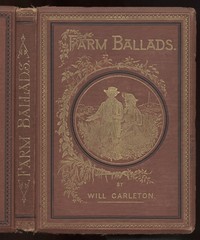
Farm Ballads — A Closer Reading
(0 User reviews)
50
Project Gutenberg
2004
Farm life -- Poetry
Readers of public-domain and historical texts
Project Gutenberg digital edition
en
Edition facts
Words: 19,147
Reading time: 84 min
Text sections: 3
Source:
Project Gutenberg record #9500
Will Carleton's 1873 collection of narrative poems in dialect, focusing on rural domestic life, marital strife, and community bonds. The excerpts reveal a speaker who uses colloquial speech, vivid imagery of farm and fire, and a conversational tone to tell stories of love, loss, and reconciliation.
Will Carleton's Farm Ballads (1873) presents a series of narrative poems written in a rustic dialect that captures the rhythms and concerns of 19th-century rural life. The preface acknowledges the poems were composed 'in the open air, with team afield' and amid other distractions, a claim borne out by the direct, unpolished voice of the verses. The catalog subject 'Farm life -- Poetry' accurately describes the setting, but the excerpts show that Carleton's focus is less on pastoral description and more on domestic drama—marital quarrels, reconciliations, and sudden crises like a house fire. The poems are structured as first-person monologues, often addressed to a listener, creating an intimate, storytelling quality.
Dialect as a Window to Character
The poems employ a thick rural dialect that serves not merely as local color but as a marker of the speaker's social position and emotional state. In 'Betsey and I Are Out,' the narrator uses contractions and nonstandard grammar ('I'm sick of all this foolishness,' 'We've lived together twenty years') to convey a plainspoken, aggrieved tone. The dialect is consistent across poems: 'Gone with a Handsomer Man' uses 'mogged along' and 'snapped up my wife quite surly,' while 'Over the Hill to the Poor-House' employs 'I'm old and I'm helpless.' This linguistic uniformity suggests Carleton is crafting a single, representative rural voice rather than individual character speech. The effect is to make the speaker seem authentic and relatable, though the dialect occasionally slips into stereotype.
Domestic Conflict and Sudden Crisis
The excerpts reveal a preoccupation with marital tension and its resolution through dramatic events. In 'Betsey and I Are Out,' the narrator describes a quarrel over a new church organ, with the wife insisting on 'praise the Lord by note' while the speaker resists. The conflict escalates to a standoff, but the poem ends with a reconciliation. More strikingly, 'Gone with a Handsomer Man' depicts a father's rage at his daughter's elopement, followed by a house fire that nearly kills her. The fire scene is rendered with sensory detail: 'smoke a-settlin' round us,' 'fire a-roarin' an' roarin'.' The crisis forces a change of heart, and the father embraces the son-in-law. These poems use catastrophe to resolve domestic strife, suggesting that only extreme events can break stubborn pride.
The Role of the Listener and the Moral Frame
Many poems are framed as direct addresses to a listener, often a child or spouse. In 'Gone with a Handsomer Man,' the narrator repeatedly says 'children' and 'if ever it happens, children,' turning the tale into a cautionary lesson. Similarly, 'Betsey and I Are Out' begins with the speaker complaining to an unnamed confidant. This framing device creates a sense of oral storytelling and moral instruction. The poems often end with a pointed moral: after the fire, the father says 'I rather think it'll happen you'll wish you'd a-kept asleep,' and the final stanza reveals the daughter is now the listener's mother. Carleton uses these frames to soften the harshness of the conflicts, reminding the reader that the stories are meant to teach forgiveness and humility.
Readers approaching Farm Ballads should expect narrative poems that prioritize story over lyricism. Carleton's dialect can be challenging but rewards attention with vivid character and incident. The poems are best read aloud to catch their rhythm and colloquial humor. While the catalog subject 'Farm life -- Poetry' is accurate, the excerpts show that Carleton's true subject is the emotional landscape of rural families—their quarrels, losses, and hard-won reconciliations.
There are no reviews for this eBook.
Reader reflection
Before you leave, reflect on the book
Use these questions to collect your thoughts before moving on.
Your progress
0
/
10
2
How much did you enjoy the reading experience?
3
How likely are you to recommend this book?
4
How easy was the book to follow?
5
Was the book easy to understand?
6
Would you start a conversation about this book?
7
How would you describe its reading pace?
8
Did the book deliver what you hoped for?
9
In one sentence, what did you learn?
10









Cristina Moore - 3 weeks ago
Stephen Lee - 2 weeks ago
Robert Maynard - 2 weeks ago